


Most of us would probably prefer not to examine our ‘number twos’ all that closely. We’d rather flush and forget.
But getting familiar with the shape and consistency of our bowel movements can help us better manage our health. So, how can we learn about our health from our stools?
That’s where the Bristol Stool Chart can help us.
The Bristol Stool Chart is a 7-type scale that can help you assess your bowel health. You can use it to help identify likely problems like constipation or diarrhoea.
The Bristol Stool Chart groups stools into 7 types, based on relative firmness and appearance.
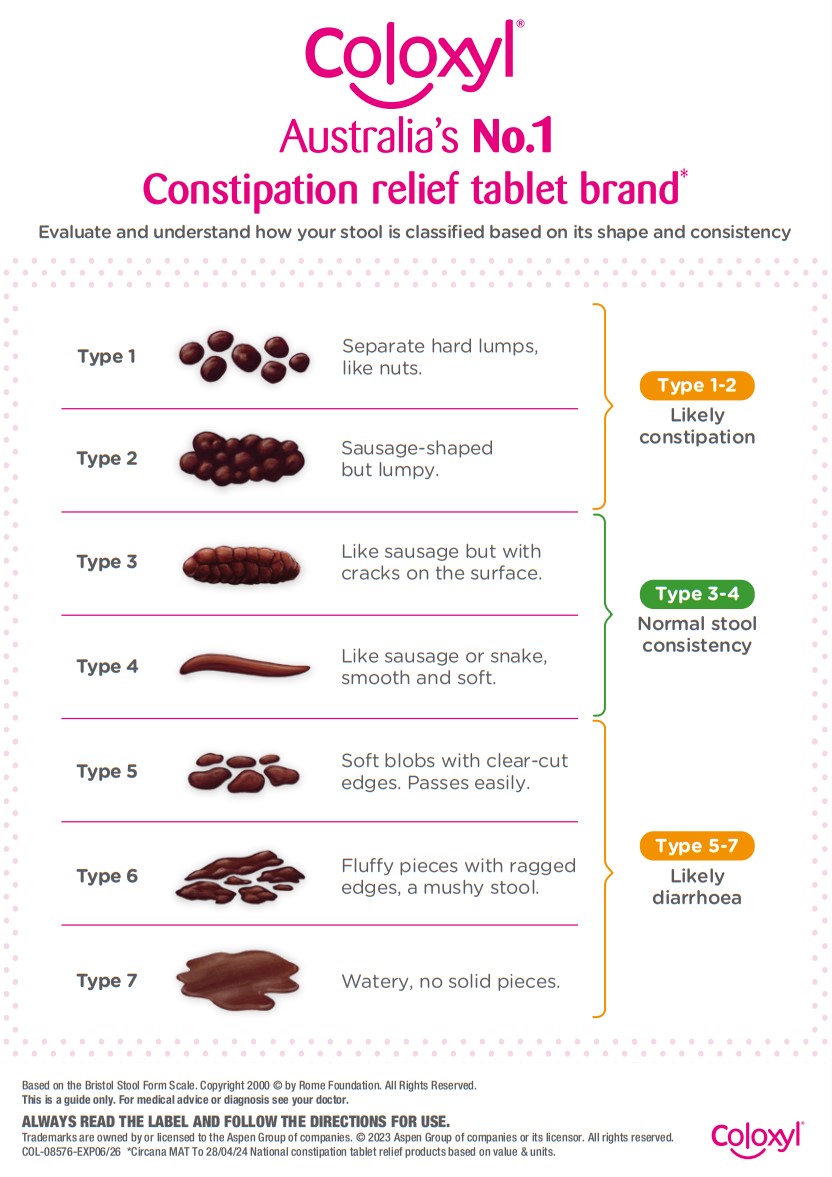
If your stool is hard and difficult to pass (types 1 and 2), you are likely constipated. If your stool is loose and watery (types 5 to 7), you may be experiencing diarrhoea. Normal stool consistency stool is well-formed and easy to pass (types 3 and 4).
This is a guide only. For medical advice or diagnosis see your doctor.
Let’s face it, the idea of looking at your stools can leave some of us feeling a bit… yuck.
The Coloxyl Bristol Stool Chart — brought to you by Stefan the stool expert — helps to make it easier. Here are the 7 types of stools according to Stefan:
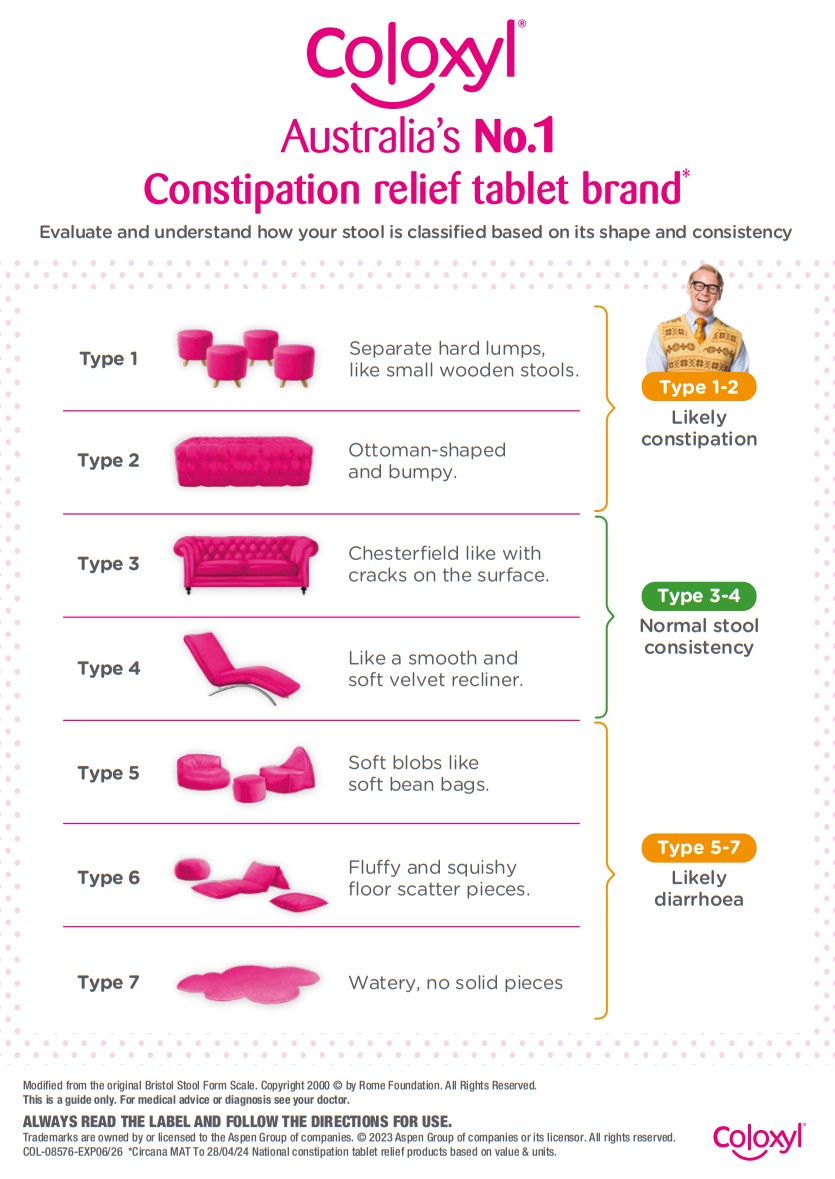
This is a guide only. For medical advice or diagnosis see your doctor.
Stool shape and consistency can vary, even between individual bowel motions. It’s important to pay attention to what your stools look like to get a general idea of what’s normal (and not normal) for you. It’s recommended that you discuss changes in stool texture and colour with a medical professional. If you have any of the following, check in with a doctor:
These symptoms can be caused by medical conditions, infection or medication side effects. Your doctor can help to determine the underlying cause of your symptoms and recommend appropriate treatment.
You can also follow the tips below to help you maintain healthy bowel function
There are a number of things you can do to maintain healthy bowel function, including:
Fibre helps to keep stools soft and regular. Good sources of foods high in fibre include fruits, vegetables, whole grains, and legumes.
Water helps to keep stools soft and regular. Aim to drink 1.5L–2L of water per day, or more if you are active or live in a hot climate.
Exercise helps to stimulate the digestive system and promote regular bowel movements. Aim for at least 30 minutes of moderate intensity exercise most days of the week.
Don’t ignore the urge to go to the bathroom. Holding in stools can lead to constipation.
Straining during bowel movements can put unnecessary pressure on the back passage (rectum and anus). If you are having difficulty passing stool, try taking a warm bath or using a stool softener.
By noticing the shape of your poo, you’ll help keep your bowel in great shape. You can check your stools every few days against the Bristol — or Stefan — Stool chart, to learn what’s normal for you. The stool chart can also help you learn what’s not normal.
If you have any concerns about your bowel health, be sure to talk to your doctor
Welcome to the Coloxyl constipation symptom and solution checker
The Coloxyl “Am I constipated” tool will help you to determine if you may or may not be constipated based on your response to 4 simple questions regarding your bowel movements.

Find answers to commonly asked questions about constipation and its causes, and which Coloxyl product is suitable for you.
The Bristol Stool Chart is simply a tool that helps you assess your bowel health. It groups poo into seven different types of stool, ranging from type 1 (hard, lumpy pellets) to type 7 (watery diarrhoea). The chart was created by a group of doctors in the 1990s to help people describe their stools to their doctor in more detail. This detail can help your doctor diagnose and treat bowel problems.
You don’t need to refer to the Bristol Stool Chart every time you do a poo. Just check in with it every few days to get a general sense of your bowel health. If you notice any changes in your stool type, frequency, or consistency, it’s a good idea to talk to your doctor.
Yes, both medications and specific foods can affect stool type.
For example, certain medications, such as opioids and iron supplements, may cause constipation. Other medications, such as antibiotics and laxatives, may cause diarrhoea.
Some foods, such as dairy or excess fibre, can also trigger diarrhoea.
If you notice a sudden change in your stool type, or if your stool is consistently unhealthy (for example type 1-2 or 5-7), speak with your doctor. They can help you work out the underlying cause of your symptoms and suggest appropriate remedies.
The Bristol Stool Chart is one way to assess your stool. You and your doctor may also want to note:
If you’re worried, your doctor can order stool tests to check for infection, blood, or other problems.
Hydration is key for healthy stool formation. When you’re dehydrated, your stool can become hard and lumpy, making it difficult to pass. Aim to drink 1.5L – 2L of water per day to stay hydrated and help keep your stools soft and regular.
The Bristol Stool Chart can be used to assess bowel health in people of all ages. However, there are a few age-specific variations to keep in mind: